Kitte Club Members Manual
Searchable document for all things studio!
*for folks who have joined before Oct 1, 2026 please review and e-sign your name so we are all up to date on current studio procedures.
Thank you!
Kitte Club Ceramics Studio Members Manual
INDEX
The Members Manual
Kitte Club’s Mission
Memberships
Payment for Memberships
Ending or Downgrading Membership
Members Page & Studio Emails
Booking a Session
Use of Equipment and Studio Tools
Injuries in Studio
Clay
Washing up
Glazes
Studio Material Orders
Storage Space and Studio Shelves
Locking Doors
Security Cameras
Noise
Misconduct and Termination of Membership
Workshops & Event
Studio Markets
Studio Visits & Friends in Studio
Animals in Studio
Kiln Firing at Kitte
Helpful Information About Firing
FAQ’s
…
The Members Manual
The Members Manual is here to outline everything as clearly as possible in the studio as a living searchable document to help you find studio protocols and answers to frequently asked questions. Every time a recurring or helpful question comes up, or we find something missing it will be added to the manual to help folks! If a question comes up you can search it here first to get an immediate answer. Of course if you have questions that are a bit more technical, specific or pressing please contact Jes directly through email kitteclubceramics@gmail.com or phone 613-897-8887, please know it may take up to 48hrs to get a response, call if there is an emergency.
A lot of this is a review from the contract but with more clarification to help everyone!
2.Kitte Club’s Mission
Kitte Club was made to welcome artists into a studio space where they can experiment, play, create, and connect. We are first and foremost a community studio trying our best to support artists and makers of all different backgrounds, careers, and experience levels with various levels of memberships to fit time commitments and budgets. Unlike some ceramic studios we put members first, focusing on open studio times and flexibility in accessing the studio and making what you want to make as here if you are a member this is your studio.
We have a small number of workshops and events to open our studio to potential new ceramicists, and host members and outside artists to teach exciting workshops open to members and the public to develop new skills and or try something new.
This is a small studio run by a ceramicist, for ceramicists.
3.Memberships
Currently there are 5 different types of memberships, below outlines their specifics:
Part-Time
Recommended for the moonlighting ceramicist, or ceramicist who moonlights elsewhere. Great for production potters!
$440.00 (400.00+hst) per month
16 sessions per month (4 hrs a session)
1.5 - 2 Studio Shelves for Storage (based on need and availability)
1.5 - 2 kiln shelves per month firing (bisque & glaze)
Extra firings based on availability for additional costs at $25 per shelf
Access to studio tools, equipment, in house glazes & members events
15% off workshops
Occasional
Recommended for the ceramicist building on skills and experimenting
$260.00 (225.00+hst) per month
8 sessions per month (4 hrs a session)
1 Studio Shelves for Storage (based on need and availability)
1 kiln shelf per month firing (bisque & glaze)
Extra firings based on availability for additional costs at $25 per shelf
Access to studio tools, equipment, in house glazes & members events
15% off workshops
Dabbler:
Recommended for the ceramicist who needs flexibility in visits and or is beginning to define their practice
$180.00 (160+hst) per month
4 sessions per month (4 hrs a session)
0.5 Studio Shelves for Storage
0.5 kiln shelves per month firing (bisque & glaze)
Extra firings based on availability for additional costs at $25 per shelf
Access to studio tools, equipment, in house glazes & members events
15% off workshops
Here for a Good Time:
Recommended for the artist who needs flexibility for practice here and there with a “pay as you go” plan. This membership cannot support production potters and is not a temporary pause membership.
$55.00 (48.70+hst) pay per session (4hrs a session)
Community shelf storage (shared)
Kiln firings for additional cost $25 per shelf, maximum 1 kiln shelf per month, more if available
Must commit to a minimum of 10 sessions over a 4-6 month period.
Access to studio tools, equipment, in house glazes & members events
15% off workshops
Here for a Project: Price and availability to be determined based on project, must have a consultation with Jes. A separate contract will be prepared indicating the specifics of price and inclusions for this type of membership based on the project you’re looking to get made.
It is asked you stay at a membership tier for a minimum of 4 months, “Here for a Project” is the only exception as term length is determined upon consultation for said individual project.
4. Payment for Memberships
○ Payment in full for Full-Time, Part-Part, Occasional, and Dabbler members must be sent on the first of each month via e-transfer to kitteclubceramics@gmail.com or unless otherwise specified for alternative payments. Members must also sign the membership contract and waiver.
○ There is a 3 day grace period to receive members payment meaning payments must be received latest by the 3 days past payment date (i.e the 3rd of each month by 11:59pm or if paid mid-month the 18th by 11:59pm). This is to help folks with transfer limits, or if you forgot the first day!
○ If members payment is past the grace period please add $15 to your etransfer/mode of payment as a late fee
○ Here for a Good Time, Not a Long Time membership must be paid upon completion of session or prior to through the members page under the “single session” payment.
○ We do not currently have any membership leaves or stop out options to temporaily suspend membership, but may be transferred to another person with approval from Jes prior to agreement and a contract must be signed. Or discuss options with Jes.
5. Ending or Downgrading Membership
○ You must provide a minimum 30 day notice before terminating your membership. If you fail to do so the lease will continue as agreed upon in initial signing and or updated lease (through written email), whatever is the most recent. This is applicable for all monthly paid memberships.
○ You must provide a minimum 30 day notice before downgrading your membership and this must be discussed and agreed to by both parties via email. This provides time to find someone to take over that membership. Membership changes can only be made if a spot is available and need written agreement from the Studio Owner.
6. Members Page & Studio Emails
○ All members will have access to the studio calendar and members page online through kitteclub.ca to see what is going on, book studio sessions, see the firing schedule, pay for clay and material orders, sign up for workshops and events, see when studio and member’s events are happening and more. This is the best place to reference studio happenings and stay up to date on info.
○ The member’s page password is: pigeonsrneat
○ Studio Update Emails go out about once per month. These emails contain vital information and are expected to be read carefully by all members. They outline upcoming events and happenings, any updates on studio protocols, reminders, to get in on material orders, door code changes, and more. Please always read carefully and in its entirety.
7. Booking a Session
Go to kitteclub.ca and scroll down the home past the calendar to find the “members page” button in purple
This has a calendar of all happening in the studio so you are aware of what’s going on for workshops, etc.
Click “Members page” button in purple
Enter password:pigeonsrneat and then book your sessions!
You can book your sessions up to 30 days in advance
Please book for what you want to do! Either Wheel or Handbuilding space for what you want to do that day, if there is space you can jump around!
You are available to book back to back sessions (i.e a morning and afternoon on the same day) if there is availability
You can book up to 1min before a session begins
You can cancel up to 2 hours before your session through the email sent to you through “Calendly.com” check your email confirmation for that cancellation link. If you do not cancel your session it will be counted as a session used
Please if you aren't attending or you are switching your time, cancel your session as this is what I use to make sure all sessions are paid and so others can access that time
If you want to do a session and miss the booking opportunity, i.e it’s 9:05 and the block is gone, book the following session block (or one in the same day) to make sure your sessions are documented
You are able to split sessions (i.e 2hrs & 2hrs, 1hr & 3 hrs) - to do this you must indicate how you are splitting your session in the “anything to add” section and write how you are splitting the session. Sessions can only be split over 2 sessions.
A few sessions a month are blocked off for classes and events which can be seen on the studio calendar, and that session will not be available for booking
Lastly note how many sessions you have for your membership and you can use them at anytime that month, it doesn’t have to be each week (i.e Occasional members have 8 sessions per month, they can do 3 the first week, 2 the second, 1 the third, and 2 the last week of the month - whatever works!)
8. Use of Equipment and Studio Tools
○ Training
■ Training will be given on all equipment and tools how to properly set-up, use, clean, and put back by the Jes, you must receive a verbal or written OK from the Jes to use the equipment. If you ever need a refresher on how to use something please ask the Jes to schedule a time to do this.
○ Tools & Equipment Use
■ Tools are to be used safely and responsibly at all times. If you are ever unsure how to use something please refrain from using them until you receive training.
■ Tools should be cleaned and set back to where they belong after use. If you’re concerned about misplacing tools, take a photo of the shelves for reference!
■ The kiln is not to be used by anyone other than the Jes & the kiln tech. Please also to DO NOT PUT ANYTHING ON THE KILN.
○ Damages & Loss
■ You are responsible financially for any damages or loss you commit to the studio and equipment including but not limited to: The Studio Space, Furniture, Tools, Equipment, Kitchen Items, and Work in the studio. If any damages occur that can not be fixed you are responsible to pay for the damages and or replacement.
■ Any damages or loss must be immediately reported to Jes.
■ If you find something of yours lost or damaged please inform the Jes, they will try to help with review of cameras to find who may have been responsible- please note that Kitte Club Ceramics Studio is not responsible for any loss or damages to your work or personal items
9. Injuries in Studio
○ Any injury incurred in the studio needs to be brought to the attention of the Jes. A first aid kit is available for minor injuries, any injury requiring more attention should be brought to a doctor or hospital, and the emergency contact will be immediately notified.
○ The studio is not responsible for any injury that may incur in the studio, to you, guests or pets you bring into the studio, this includes death. You must sign a liability waiver before working in the studio.
10. Clay
○ This studio uses CONE 6 CLAY ONLY
○ Clay is not included in studio memberships, it is available for purchase from the studio on a self-serve basis using the membership page. Please make sure to take the proper amount of clay and type purchased and make sure that any other bags are not left open when taking your clay.
○ There will be a few types of cone 6 clay bodies available. If you want something specific you can request specific clay from Tuckers that can be added to the studio order with advanced notice or purchase yourself with prior approval from the Jes.
○ Once clay is purchased clearly label bag with your name and keep on your shelf or in the clay storage area - any unlabeled clay will be returned to the studio
○ Reclaiming clay
■ You are welcome to reclaim your clay, this is to be kept on your shelf or in the clay storage with your name. If you have no interest to it can be donated back to the studio. Please put the scraps from the same clay into a “reclaim clay” bucket under the wash bins and the studio will reclaim it for future use
11. Washing up
○ There will be designated wash bins to wash tools, hands, bats, boards, splash guards, etc. Please clean the clay off in the correct “clay wash” bin. The Jes/owner/staff will clean out and tend to the bins. If there is an issue or the bins need changing please let the Jes/owner/staff know.
○ ABSOLUTELY NO CLAY OR PLASTER IS TO BE PUT DOWN THE SINKS OR TOILET
○ Tools, equipment, etc. must be cleaned after finished using, dried, and returned to where they properly belong. Do not leave tools or equipment out.
○ Tables must be wiped down before leaving, cloths and sponges rinsed and hung/left to dry - dirty cloths can be put into the hamper behind the wash bins to be washed
○ Clean the area you were working of any debris, table, chairs, floors, etc. the space should be cleaner than when you came in. Make sure to always mop before leaving and put away any dishes.
○ Put away your work onto your designated shelf or extra work space before leaving
○ If you put glaze in the clay wash please pour the entirety of the bin into a clean bucket found underneath the black table - remove all clay using the water from the bin and a sponge. Once clean refill the wash bin and place bin of contaminated water by the black table with a note for Jes.
12. Glazes
○ A variety of cone 6 glazes will be available in the Studio for your use
○ You can purchase your own underglazes and Cone 6 glazes (with approval from the Jes prior to purchase) to use, make sure to clearly label each glaze with your name and put them on your shelf / labeled storage area
13. Studio Material Orders
○ Studio orders are made on an irregular basis. But once a studio order is being made there will be an email to ask if you would want anything added to the order - if so please respond within time outlined with your specific order which will be added to the Studio order
■ Once the order is confirmed you will receive an email listing your items and prices for your items plus a charge for shipping/handling (much reduced from an individual order as it is shared). This email will have instructions on how to pay through the members page and must be paid by the date listed or extra fees will be added.
■ Your items from the order will be put onto your shelf or on the front counter. The arrival of this order is up to the store’s processing times and shippers, I cannot control when a shipment comes.
14. Storage Space and Studio Shelves
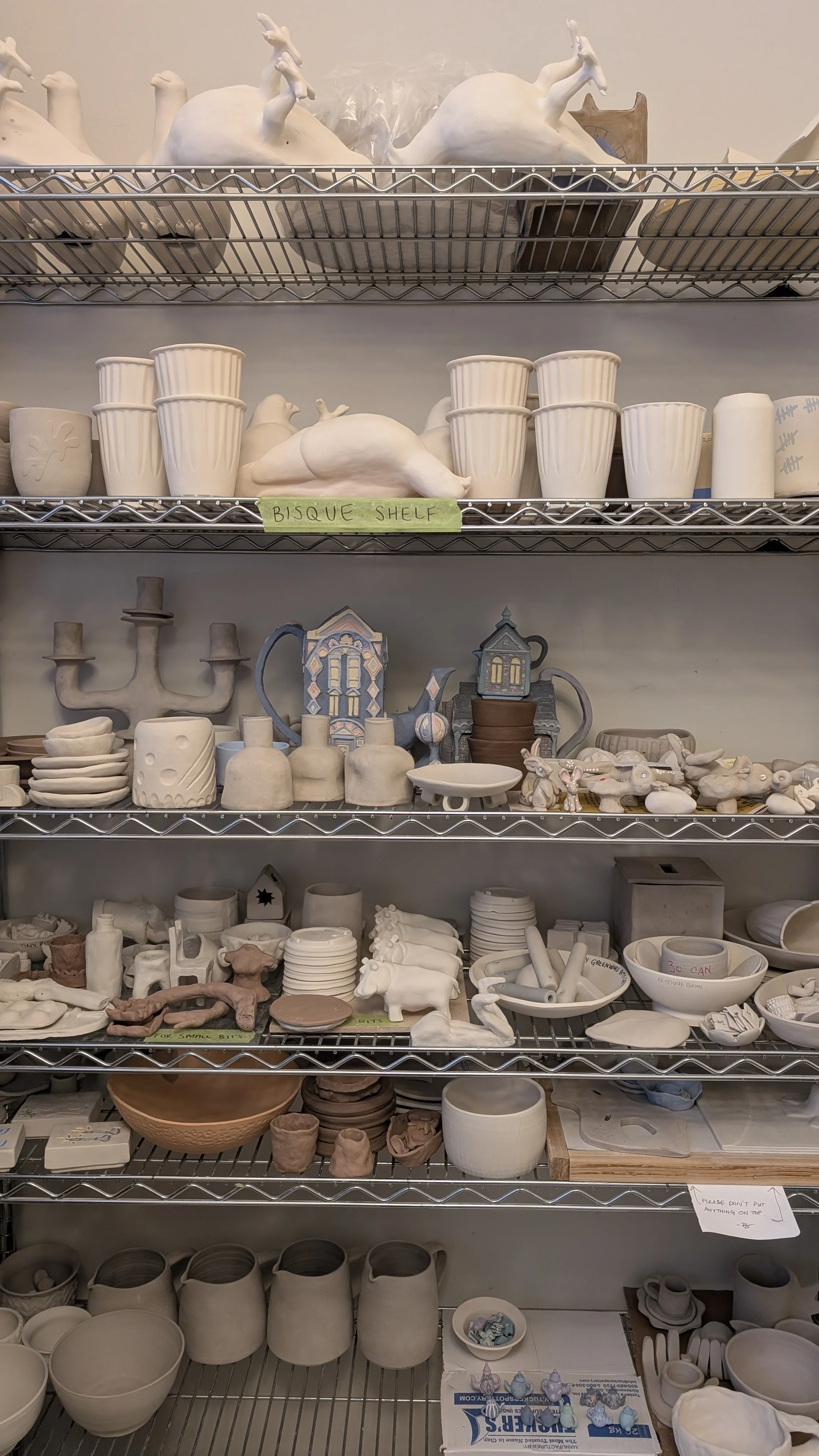
○ You will be given designated studio shelves or spaces to store your work, tools, aprons, etc. There is community storage temporarily for overflow items on top of the members shelves - this space if for everyone and for works, no clay, glazes, tools or anything else. If you need more space, talk to the Jes and we’ll try to find extra temporary storage, no guarantees.
○ If someone else’s work is in your storage area DO NOT MOVE IT. Please notify the Jes/owner/staff and they will solve this issue.
15. Locking doors
○ There will be studio keys attached to the front pipe in a lock box. The code will be given to studio members and will be reset on a regular basis for security reasons, code updates will be given as they are changed. Check the door before getting the key from the lock box as there may already be someone in the studio.
○ Upon unlocking and locking the doors the key must be returned to the lock box and relocked.
○ If you are the last person in the studio you are responsible for locking BOTH studio doors and returning the key to the lock box and relocking it. If there are any incidents caused by the door left unlocked by you, you are fully responsible for covering the costs of damages and loss.
○ If you are alone in the studio and feel unsafe you can lock the door behind you, just make sure the key is returned to the lock box so other members may access the studio.
○ DOOR CODE: 450#1
16. Security Cameras
○ There is a security camera installed in the studio that records image and sound while you are in the studio.
○ Please note the footage will only be used in case of incident or theft to refer to and will not be released to the general public.
17. Noise
○ The studio is open 24/7, those working late night (after 11pm) / early hours (before 9am) must keep noise levels low during this time for surrounding neighbours and residents. No power tools or loud media during this time.
18. Misconduct and Termination of Membership
○ Any sort of misconduct from the studio outline/manual can result in an immediate termination of membership. The Studio Owner, Jes Young, will inform you if this is the case and the Studio holds the right to dismiss those who have made the infractions for the safety of others in the studio and of the studio itself and does not need to provide physical evidence of these infractions.
○ If your membership is terminated you will not be reimbursed for membership fees, and will have to schedule a time with the Jes to collect your work and other items from the studio.
○ Deliberate or repeated misuse of tools and equipment, or using studio equipment without training or authorization from Jes can result in termination of studio membership.
○ Stealing from the studio or members in the studio, whether physical items or intellectual property will not be tolerated and will result in termination of membership.
○ Refusing payment for services or consistent missed or incorrect payments can result in membership termination.
○ Hateful speech, intimidation, and or bullying will not be tolerated in the studio. Any use of hateful speech to anyone in the studio at any time can result in an immediate termination of membership and immediate removal from the studio.
19. Workshops & Events
○ Workshops & events are scheduled and rolled out at various times and dates. Exact dates and times will be listed on the studio calendar (online and in person). Sessions may be blocked off while workshops happen. If a session is booked off you may not be in the studio at this time (the time slot will not be available to book).
○ Colour coding on the in person calendar is as follows:
Blue: Studio booked off entirely for an event or workshop
Purple: A workshop is happening but there is still sessions available
Green: Bisque firing
Red: Glaze Firing
20. Studio Markets
○ Seasonal markets will happen around the beginning of December and if other local events coincide to make it worth while for everyone - exact dates to be decided and there will be advanced notice to members if they want to participate then an open call will be released for outside members to participate.
○ To participate you must apply and pay a market fee to sell items, but no further commission is taken on items unless otherwise specified.
○ You will be given a designated space to place / hang your items, if you want more space you can pay an additional market fee if there is still space available.
○ At markets you can sell items other than ceramics (i.e candles, soaps, paintings, prints, clothing, etc)
○ Markets will be for 1-2 days, the exact time to be determined. The studio is closed for working during the market days, the night before for set up, and a few hours after for take down - the sessions will be booked out.
21. Studio Visits & Friends in Studio
○ Studio visits from friends, family, other artists, and curators are a-ok. Please be respectful of other artists using the space when you bring in visitors (i.e noise levels, where their things are put, number of bodies in the studio, etc)
○ Friends and family of members can purchase a Pal’s Pass to work with the member bringing them in. They must both book out a session to do this. More info and specifics are on the members page under “Bringing a Pal / Pals Pass”. The member bringing in a guest is entirely responsible for showing studio protocol, guidelines, and are responsible for any damages that may occur while their guest is in the studio. The guest or pal must follow studio protocols and guidelines, and can be asked to leave or banned from the studio if there is misconduct.
Studio guests must sign a waiver to work in the studio.
The studio owner reserves the right to deny or dismiss studio guests and pals passes for any reason and does not need to disclose any reason.
22. Animals in Studio
■ Well behaved animals are welcomed in the studio. If there are any issues you must take your animal home immediately whether from not getting along with another animal, excessive noise, damages, breakage in the studio or any other member in the studio being uncomfortable with the animal being there.
■ You are responsible for your animal and will not leave them in the studio unattended. You are responsible for any damage or injury caused by your animal.
■ Kitte Club is not responsible for any injury, including death, that may happen to your animal while in the studio or resulting from being in the studio
23. Kiln Firing at Kitte
○ Kiln loading and firing services are provided by the studio owner and technicians - NO ONE IS GIVEN PERMISSION TO TOUCH OR USE THE KILN OR KILN COMPONENTS UNLESS WRITTEN CONSENT BY THE STUDIO OWNER JES YOUNG.
○ Firing service customers/members use the kiln service at their own risk. I will always do my best to have successful firing work for my customers, but also I accept no responsibility for damage caused during the firing of the kiln or handling of the work.
○ Information about clay, slip types their firing ranges, glaze and its particulars enables us to fire your work in the most efficient way, and ensure it fits the framework of your project, and minimizes possible damage firing can cause. If your project is complex and requires large commitment from the kiln technician, I may only be able to carry it out with an advance arrangement. I do not fire raw glazed work and unknown clays in the studio kilns to minimize possible damage to the kilns and work itself.
○ For health and safety reasons I cannot fire anything that would create a vast amount of smoke/heavy smell, i.e. clay having a significant amount of organic materials inside, paper clay or materials that produce toxic fumes while burning.
○ For Our regular kiln firing temperatures are Cone 04/05 for bisque firing, and
Cone 6 for glaze firing.
○ I will refuse firing of work that isn’t safe for the kilns or surrounding work, or which might cause serious damage to the equipment, or may pose a health and safety threat. I reserve the right to refuse firing any work that may cause damage to the kiln and other work.
○ If your work damages the kiln shelves or kiln elements you will be charged the replacement cost. If you are firing glazes that will run, please make kiln cookies for your pieces. If you have no experience using a particular glaze, please make tests before glazing large work to avoid disappointment. Please provide full information about personal glazes before firing; doing so will greatly reduce the risk of damage and will help me provide best service. If your work damages other pieces in the firing, you will be charged the cost of firing of the damaged pieces. If damage to your work occurs during a shared firing, you will not be charged.
○ Timing: I process work as quickly as I can. Please allow 1 to 4 weeks for a firing, and plan in advance. When you put your work on the firing shelves to be fired, your work must already be bone dry for bisque firing, and glazed work fully ready for a kiln, with bottoms wiped and kiln furniture requested if needed. If you want to use your own kiln furniture please request and have it ready for the firing, I am not responsible for any damage or loss of personal kiln furniture.
○ Please be aware the work may be photographed while in process. Please let me know if you prefer images of your work to not be shared on social media. Help me support wellbeing at the workplace and notify me if your work has explicit or sensitive content
○ Firing timings are all posted to the members page. I reserve to change the firing may dates at anytime for any reason (damage, maintenance, not enough to fill, improper practices, etc)
○ I fire works based on what’s best for the kiln, the pieces being fired, the studio members, and the studio as a whole. Sometimes not everything will fit into or are not right for the packing (loading) of the upcoming scheduled firing. I reserve the right to push pieces to another firing (and can push for multiple firings if necessary) to do what is best for the pieces being fired, the kiln, studio members, members deadlines (with prior communication), and any other reason given. I do not need to explain my decisions for choosing what works are put into what firing. I make no guarantees or promises to meet specific deadlines for firing, all are requests.
○ Communication (for outside firing) You will receive an invoice, and a confirmation of completion time as soon as possible given my firing schedule. Please pay invoices in full either before collection as directed in emails, through the Kitte Club website, with membership kiln allowance or cash when picking up work. We are unable to provide updates on the progress of firings and will communicate when the kiln is unloaded only through the members page. You will be charged for damage your work causes, as outlined above. Make props and kiln cookies for anything challenging or experimental. Extra charges apply for slower programmes or firing of large sculptural work that demands a slower curve. I reserve the right to refuse service with no explanation. I may not be able to accept new work if the studio is too busy, if you have unsettled invoices, or unreasonably short deadlines.
24. Helpful Information About Firing
A little bit about what goes into a firing, because many, even those practicing for years, have never fired their own kiln. So here’s a brief breakdown to give some information:
TO BEGIN
Kiln firings need to be loaded in specific ways to try to achieve consistent accurate results. This is done by:
Researching, experimenting, and understanding kiln firing programs. I use my own (not a preset) that is better suited for a large array of works. I calculated and determined the ramping temperatures, hold times, peak temperatures, and cooling to try and ensure consistent successful firings for a medium that has so many points of potential failure.
Each time before we fire we check the kiln for any sign of damage, clean it, and make sure it is safe to fire.
Witness cones are added into the firings to verify the performance of the kiln, even heating, and that the proper heatwork is being done to achieve a proper firing to whatever cone you are after. This helps keep an eye on the kiln health and loading strategies so every piece in that firing is fired properly.
LOADING A KILN
You have a max number of kiln shelves that can go into a firing. This is because of the weight of each shelf, the kiln floor has a limit and can break. The shelves also retain more heat than the works themselves as being 50lb solid High Alumina cement. The more shelves, the more heat is held and I have to adjust the program to accommodate this.
Loading must be balanced on each and every shelf. I have to take into account the size, weight, clay type, and glazes (for a glaze fire) for each and every piece, and place it into the kiln strategically to allow for even weight and heat distribution as well as air flow. Pieces have to be relatively similar to be placed on the same shelf, then tetrised into place before choosing the kiln post to determine the height for the next shelf that will allow for the proper amount of airflow and negative space. This makes sure everything heats and cools evenly to avoid “hot spots” or over/underfiring in spots in the kiln.
Folks often request cookies and stilts for glaze fires - each must be tested before to ensure it will fire well and then be carefully balanced into the kiln. There are only so many stilts, cookies, and kiln furniture so sometimes there is not enough to fulfill requests for all in a single firing.
Multiple flat items, whether small or large, are the hardest to fire, due to the thin nature of the pieces to ensure nothing warps or slumps, and that they take up a lot of shelf space without any height to fill the kiln better.
Loading the kiln is hard physical work. They take on average for our studio (because of so many small objects) 3-5 hours, of lifting 40lbs discs above our heads and into the kiln at ankle, shin, knee, hip, and rib heights. Then we must lay out each piece strategically onto each shelf with the requirements it needs to be fired successfully (stilts, cookies, buffer space between objects). Unloading is just as physical and takes from 1-3 hours, meaning each firing takes on average 5 - 8hrs of hands on work to make happen. When folks ask if I can add on an extra firing I need to make sure it is proper (there is enough work), and I have the time in my week (a potential additional 8hr work day plus potential maintenance time and labour) to do so properly.
Bisque fires are also tricky. The fuller a bisque firing is the better and more evenly it fires as it takes more time to slowly heat up and cool down - catering to all types of clay bodies. Items stacked into each other help add more items, and make a nice tight bisque fire, while also keeping folks’ small pieces together. Bisques are loaded even more carefully due to the handling of delicate greenware, and we have to be aware of the shrinkage rate of each type of clay body used. When items are placed into other items I need to make sure that one won’t trap the other.
I allow members to use undergaze and ceramic stains in greenware, darker pigments can cause flashing, so those pieces must be isolated, put onto a cookie or need to wait for another firing for more space. Flashing is a superficial issue that can be removed from a quick sanding. I try my best to avoid it, but it isn’t always apparent which stains and underglazes are used, and I rely on members to give me a heads up, or intuition.
After a firing, each part of the kiln and shelves are inspected. Kiln shelves need regular maintenance to perform effectively and if any damage occurs (glaze drips, fusion) the shelf must be meticulously grinded by hand until there is no glaze left, then washed and reapplied with 2-3 layers of kiln wash. This is laborious and depending on the damage can take hours and extra materials to solve.
Work wasn’t fired as expected?
No matter how much experience and firings a kiln operator does, kiln firings can go anyway due to a number of unpredictable happenings like:
Off-gasing
Chemical imbalances in glazes comboed together (glaze sputtering, crawling, crazing)
Improper glazing techniques
Glazes, engobes, underglazes or overglazes that aren’t compatible with specific clay bodies
Refiring a piece
Unpredictable outcomes are a part of ceramics. Sometimes we love the result, sometime we hate it but this is why ceramicists have the motto: NEVER GET ATTACHED ;)
Mechanical Failures & Replacing Elements/Components
We fire with an electric kiln, meaning that another absolutely unpredictable but definite possibility in any firing is a mechanical failure. This can happen if any individual component, even if there are multiple in our kiln, listed below fails (breaks). Again, this is unpredictable.
Thermocouple failure (we have 3)
Element failure (we have 6)
Relay Failure (we have 3)
Fuse Blows (we have 2)
Power outage in building
Breaker trips
Wires burning or melting
Latch switch engaging kiln breaks
Controller failure
Kiln elements and components are electrical components that go through a lot of wear and tear and need replacing after a specific number of firings.
The number of firings is not consistent as each firing itself is different based on what is in the firing (number of works, shelves, clay bodies, glazes used) there is a general number we are given from the manufacturer for our kiln. Again I stress, it is still not easy to predict just when the replacement is needed before a mechanical failure happens.
Replacing kiln elements and components is time consuming and expensive.
If a mechanical failure happens, the kiln does not read out what exactly the failure is, or what needs to be replaced. It only tells you what it wasn’t able to do (i.e was 50 degrees off the programmed ramping speed). Based on the error code I have to make a full visual inspection of each component and determine what the issue is and how to fix it. Sometimes new issues happen (i.e in April a mysterious mechanical failure that I have never experienced, nor have my other kiln techs experienced) and I have to call a kiln specialist to come, diagnose the problem and fix it.
When a mechanical failure happens, it take time to diagnose the issue, order and wait for parts to come in, then fix or schedule a service from the kiln specialist.
This is why if a mechanical failure happens members are not charged for this firing and I will refire the works when able because it is nobody’s fault this has happened, and often why we “pray to the kiln gods”.
Kiln Allowance, Scheduling, and Requests
Kiln allowance is a part of every membership. This is the amount of kiln space you have chosen to use monthly and I have agreed to, this is what I use to first determine firing schedules and amount of firings needed and then adjust based on what I see in the studio and requests made. I let members go beyond their kiln allowance if I am able and charge accordingly for the extra labour and wear on materials, but still need to make sure each and every member gets their specific kiln allowance.
I ask for members with deadlines for shows, markets, gifts, commissions, etc to let me know in writing the deadline and what they need fired by then. This is a request, if I am able to accommodate, I always do, and I often add extra firings to ensure members get what they need when they need it!
Those with deadline requests still need to follow studio protocol (i.e works bone dry for a bisque, no exceptions), if works are unsafe to fire, or there is much more than what was communicated I will fire what I can but some work may have to be left out as it was unplanned for or not ready.
If a member submits many deadline requests, especially back to back with production pottery, I can’t always accommodate as I still need to fire other members' work and keep the studio moving. Again I do what I can and often add more firings if I am able and there is enough work, and often push my own work to make space for these requests.
I fire each and every time using my knowledge and experience, and load fires based on what’s best for the kiln, the work at hand, and for all studio members.
FAQ’s
This is a living manual that Jes will update. FAQ’s will be added as frequent questions arise and more clarity can be added to help members!